STR IN ASIA: REGULATION, TRUST & STRUCTURE

Introduction

Short-term rentals across Asia have grown faster than the systems designed to regulate them.
What began as a fragmented layer of alternative accommodation is now becoming a visible part of the region’s tourism and accommodation economy. Professional operators manage large portfolios across multiple markets. Institutional capital has entered the sector. Technology platforms have expanded reach, visibility, and operational scale. In some destinations, short-term rentals now represent a meaningful share of available accommodation supply.
At the same time, pressure has been building.
Governments are facing growing concerns around housing affordability, zoning, taxation, licensing, and community impact. Europe has moved aggressively toward enforcement and restriction. Australia is increasing financial pressure through levies and permit systems. Japan has built one of the world’s most tightly controlled operating environments. Bali and wider Indonesia are now moving through their own transition, shifting from loosely regulated expansion toward registration, licensing, and enforcement.
Asia now sits at the centre of this shift.
The region remains one of the fastest-growing short-term rental markets in the world, but it is also entering a period where regulation, operating standards, and trust will shape what comes next.
This paper looks at the regulatory changes influencing short-term rentals between 2024 and 2026 across Europe, Japan, Australia, Bali, India, and Southeast Asia. More importantly, it looks at what these changes may signal for the future of the sector across Asia.
The next phase of short-term rentals will not be defined by how fast the sector grows.
It will be defined by how well it operates.
Chapter 1 - The Regulatory Reset

For years, short-term rentals grew faster than regulation.
Platforms expanded city by city. Investors entered the market aggressively. Entire villa districts appeared almost overnight in places like Bali. Apartment towers quietly shifted from residential living into tourism accommodation. In many markets, governments simply could not keep pace with what was happening on the ground.
Then the pressure started building.
Housing costs climbed sharply across major cities. Residents began pushing back against the loss of long-term rental stock. Governments started asking harder questions around taxation, licensing, zoning, guest reporting, and safety obligations. What had once been viewed as tourism innovation increasingly became tied to wider political debates around affordability, community impact, and urban planning.
By 2026, the mood changed noticeably.
This is no longer a period of observation.
It is a period of intervention.
Europe moved first and hardest. Cities such as Barcelona, Florence, and Madrid shifted from selective restrictions toward direct enforcement. The introduction of Regulation (EU) 2024/1028 marked an important turning point, forcing large accommodation platforms to share operating data directly with authorities.
Governments no longer needed to estimate the size of the market.
They could now see it clearly.
That matters because once governments gain visibility, enforcement becomes easier. Tax collection becomes easier. Licence tracking becomes easier. Political pressure becomes easier to respond to.
The old gap between what existed online and what existed legally is starting to close.
Across Asia, similar patterns are emerging, although each market is moving at its own pace.
In Indonesia, the March 2026 OSS compliance deadline signalled a more serious approach toward business registration and tourism licensing. In Thailand, pressure continues around the 30-day threshold and hotel legislation. Malaysia is moving toward stronger registration frameworks, while Japan already operates one of the most tightly controlled systems globally through Minpaku.
Australia has taken a different path again.
Rather than broad bans, several councils and state governments are using financial pressure to slow the market. Higher permit fees, tourism levies, and additional taxes are making it harder for smaller operators to remain viable.
What Regulation is Starting to Look Like
European Union
Platform data enforcement
Housing affordability
Stronger licensing enforcement
Barcelona
Tourist apartment phase-out
Residential housing recovery
Supply contraction
Bali / Indonesia
OSS licensing enforcement
Informal accommodation growth
Professional operators favoured
Japan
Minpaku licensing system
Residential control
High barriers to entry
Australia
Permit fees and levies
Housing shortage
Margin pressure
Thailand
Hotel Act enforcement
Unlicensed accommodation
Legal uncertainty
Malaysia
Registration oversight
Tourism apartment growth
Tightening compliance
Southeast Asia Overall
Formalisation phase
Rapid STR growth
Shift toward structured operation
What is happening is not simply a crackdown on short-term rentals.
It is a reshaping of the sector itself. (India – has Chapter 8)
The industry is moving away from loosely managed inventory toward licensed, accountable, professionally operated accommodation businesses. In many markets, governments are no longer trying to remove the sector entirely. They are trying to identify who belongs in it.
That distinction matters.
Professional operators with proper licensing, reporting systems, hospitality standards, and local compliance are increasingly being separated from informal or speculative supply. The gap between those two groups will likely continue widening over the next five years.
For Asia, this matters enormously.
The region remains one of the fastest growing short-term rental markets in the world. Tourism demand remains strong. New destinations continue to emerge. Investor appetite remains active. But growth alone is no longer enough.
The next phase of short-term rentals in Asia will depend on how the sector responds to regulation, accountability, and public trust.
Because the conversation has changed.
This is no longer just about demand.
It is about legitimacy.
Chapter 2 - Europe’s War on Short-Term Rentals

Europe has become the front line of the global short-term rental debate.
No region has moved faster or harder against the sector over the past two years. What began as local frustration in a handful of tourism-heavy cities has now become coordinated political action tied directly to housing pressure, affordability, and urban identity.
The numbers explain part of the reaction.
By 2024, short-term accommodation bookings across the European Union exceeded 850 million nights annually. Entire neighbourhoods across Barcelona, Florence, Lisbon, Amsterdam, and parts of Madrid were increasingly shaped around tourism rather than residential living. Apartments once occupied by locals shifted toward higher-yield visitor accommodation. Local rental supply tightened. Housing costs rose sharply.
For many city governments, short-term rentals became the visible symbol of a much larger housing problem.
That shifted the political tone quickly.
Barcelona pushed the furthest.
In June 2024, the city announced plans to remove all tourist apartment licences by November 2028. More than 10,000 licensed tourist units are expected to disappear from the formal market under the proposal. The decision later gained further political strength following legal backing tied to housing protection arguments.
Madrid followed with tighter restrictions around tourist apartments inside residential buildings, particularly within historic districts. Florence moved against lockboxes and self-check-in systems, arguing that parts of the city centre were losing residential character. Amsterdam tightened annual night caps further. Athens, Lisbon, and parts of France also continued reviewing stricter operating rules.
The pressure was no longer isolated.
It became regional.
Europe STR Regulation Snapshot (2026)
Barcelona
Tourist apartment phase-out by 2028
Housing recovery
Major reduction in supply
Madrid
Restrictions in residential buildings
Urban residential protection
Reduced investor expansion
Florence
Lockbox and self-check-in restrictions
Historic centre preservation
Higher operational friction
Amsterdam
Annual night caps
Tourism control
Reduced casual hosting
Lisbon
Licensing freezes in some districts
Housing pressure
Slower inventory growth
Paris
Registration and primary residence limits
Compliance enforcement
Increased penalties
European Union
Regulation (EU) 2024/1028
Platform data sharing
Stronger enforcement capability
At the centre of this shift sits Regulation (EU) 2024/1028.
From May 2026, major booking platforms operating within the European Union must provide standardised operating data directly to authorities through centralised reporting systems. Governments now receive clearer visibility around listing activity, guest stays, rental nights, and operator registration details.
For years, cities argued they were regulating blind.
That excuse has disappeared.
The importance of the EU framework goes well beyond Europe itself. Governments globally are watching closely because the regulation changes the balance between platforms and regulators. Data transparency now sits at the centre of enforcement.
That changes the operating environment significantly.
The era where listings could quietly operate outside licensing systems is closing quickly in many major markets. Registration numbers, taxation records, zoning approvals, and operating activity are increasingly becoming connected.
Europe is also showing something else.
Regulation does not always begin with national governments. In many cases, it starts at city level, driven by local political pressure. Tourism-heavy destinations respond first because the impact is felt first at street level — rising rents, disappearing residential supply, and visible tension between visitors and local communities.
For Asia, there are important lessons in this.
Many Asian destinations are still earlier in the cycle. The pressure is growing, but the political response remains uneven. Bali, Phuket, Kyoto, and parts of Bangkok are already beginning to experience some of the same conversations Europe faced years earlier.
That does not mean Asia will follow Europe exactly.
The political structures are different. Housing markets are different. Tourism dependency is different. But the direction of travel is becoming familiar. Governments want visibility. They want registration. They want taxation compliance. They want clearer definitions around who is operating professionally and who is not.
Europe may represent the most aggressive version of the regulatory shift, but it also provides an early warning.
Once housing pressure and political momentum combine, regulation can move very quickly.
And once governments gain access to reliable platform data, the market changes with it.
Chapter 3 - Bali and Indonesia: Oversupply, Enforcement
and the Rise of the Professional
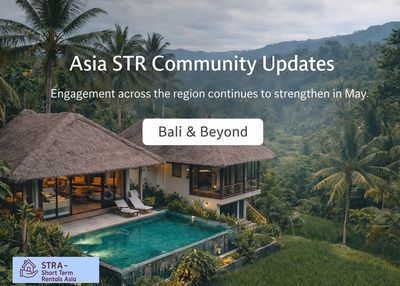
For more than a decade, Bali represented the dream version of short-term rentals in Asia.
High nightly rates. Strong tourism demand. Rapid villa development. Foreign capital flowing into lifestyle property investment. Social media amplified the image even further with private pools, jungle villas, ocean views, café culture, and remote work all feeding into a tourism machine that seemed impossible to slow down.
For a long time, almost everyone made money.
That is no longer the case.
By 2025, the market began showing visible strain. Supply growth had moved faster than demand. Entire areas of Canggu, Uluwatu, Berawa, Pererenan, and Ubud entered a construction cycle that started feeding on itself. New villas kept appearing because previous villas had performed well. But eventually the market became crowded with similar inventory competing for the same guest.
The shift was subtle at first.
Occupancy became less consistent outside peak periods. Operators started discounting more aggressively. Average daily rates softened in certain villa categories. Owners who entered the market expecting passive returns suddenly discovered the business required active management, marketing, staffing, maintenance, guest communication, channel management, and constant operational attention.
The easy money phase started fading.
At the same time, the Indonesian government began moving toward tighter oversight.
The OSS-RBA business registration framework became increasingly important across tourism accommodation. Operators who had previously worked in grey areas suddenly faced growing pressure around licensing structures, zoning compliance, tax reporting, staffing legality, and business registration obligations.
The March 2026 compliance deadlines mattered because they signalled something larger.
Indonesia was beginning to separate informal participation from commercial operation.
That distinction changes the market dramatically.
For years, Bali operated with layers of ambiguity. Nominee structures, unclear licensing pathways, unregistered villas, and inconsistent enforcement created an environment where many operators simply focused on growth first and legality later.
That environment is becoming harder to maintain.
Government departments are increasingly connected through digital registration systems. Local reporting requirements are improving. Tourism authorities, immigration, taxation departments, and regional governments are starting to align more closely around commercial accommodation activity.
The market is becoming more visible. And visibility changes behaviour.
What Different STR Markets Are Starting to Look Like
Bali
Av Yield 8%–12%
Supply Very High
Regulation Increasing rapidly
Oversupplied but still high demand.
Operational Risk - High
Jakarta
Yeild ~6%
Supply Moderate
Regulation Moderate
Stable urban demand
Operational Risk Medium
Phuket
Yeild 5%–7%
Supply Controlled
Regulation Moderate
Professionalising
Operational Risk Medium
Bangkok
Yield 4%–6%
Supply Moderate
Regulation Existing hotel law pressure
Mixed Market
Operational Risk Medium
Lombok
Emerging
Supply High new development
Regulation Early-stage oversight
Speculative Growth
Operational Risk High
Japan (Tokyo/Osaka)
Yield 4%–7%
Supply Controlled
Regulation Very high
Stable licensed market
Operational Risk Lower
Australia Coastal Markets
Yield 3%–6%
Supply Slowing
Regulation Increasing taxation pressure
Market Consolidating
Operational Risk Medium
Indicative yield ranges are based on publicly available market reporting, operator discussions, regional observations, OTA visibility, property manager feedback, and tourism accommodation trends observed between 2024–2026. Actual returns vary significantly depending on location, asset quality, occupancy, management capability, operating costs, and regulatory conditions. This table is intended as a directional market overview only and should not be interpreted as investment or financial advice.
The chart tells an important story.
Bali still produces some of the strongest potential returns in Asia, but those returns now sit beside rising operational pressure and growing market saturation. The days where almost any villa could achieve strong occupancy simply by existing are fading quickly.
The market is becoming more selective.
Well-managed villas in strong locations with experienced operators continue performing well. Weakly managed inventory is increasingly exposed, particularly during softer travel periods or outside seasonal peaks.
That separation between strong and weak operators is widening.
This does not mean Bali is collapsing. Far from it.
Bali remains one of the strongest tourism destinations in Asia for professionally operated villas and branded accommodation. In many cases, returns still outperform major regional markets including Bangkok, Phuket, and parts of Australia. International arrivals remain strong. Lifestyle demand remains powerful. Long-stay visitors, digital workers, wellness tourism, and luxury travel continue feeding demand into the island.
But the conditions have changed.
Operators can no longer rely on demand alone to carry weak operations.
The market is becoming less forgiving toward poor management, inconsistent service standards, weak revenue strategy, or unclear legal structures. Villas sitting empty for long periods are no longer unusual in oversupplied pockets. Owners are asking harder questions around profitability. Competition has intensified sharply across the mid-market villa segment.
At the same time, a more serious professional layer is emerging.
Larger property management companies are investing heavily into systems, staffing, guest experience, owner reporting, compliance, and distribution strategy. Revenue management has become more sophisticated. Brand identity matters more. Direct booking strategy matters more. Operational consistency matters more.
The market is slowly moving away from informal hosting toward structured hospitality businesses.
That is one of the most important changes happening across Asia right now.
And it is not limited to Bali.
Jakarta, Lombok, Yogyakarta, Labuan Bajo, and parts of the Indonesian archipelago are all seeing increased investor attention linked to tourism accommodation. The difference is that many of these emerging markets are now developing under far tighter government visibility than Bali experienced during its earlier growth years.
In many ways, Bali became the testing ground.
It showed how fast the sector could grow when regulation lagged demand. It also showed what happens when construction, speculation, and tourism expansion move faster than operational maturity.
The next phase now looks very different.
The winners in Bali over the next five years are unlikely to be the fastest builders.
They will be the operators who understand regulation, staffing, hospitality standards, local relationships, taxation, distribution, and long-term sustainability.
Because Bali is no longer simply a tourism story.
It is becoming an operational story.
Chapter 4 - Japan’s Minpaku Framework:
The High Barrier Model
Japan saw the short-term rental problem earlier than most countries.
Long before Europe entered open conflict with platforms and operators, Japan had already moved toward formal control. The country recognised both the economic opportunity and the risks tied to uncontrolled accommodation growth, particularly in dense residential cities such as Tokyo, Kyoto, and Osaka.
The result was Minpaku.
Introduced in 2018 through the Private Lodging Business Act, the Minpaku framework legalised short-term rentals nationally while placing strict limits around how they could operate. The most widely discussed restriction was the 180-day annual cap on guest stays.
That single number changed the economics of the market immediately.
For casual hosts, it created limitations around revenue potential and occupancy planning. For professional operators, it created a clear dividing line between hobby participation and full-scale hospitality operation.
Japan effectively forced the sector to choose what it wanted to become.
The market responded quickly.
Operators seeking year-round trading conditions moved toward more complex licensing structures under the Hotel Business Act, particularly the “Simple Lodging” category. Others focused on Special Strategic Zones such as Osaka’s Tokku Minpaku system, where minimum stay requirements replaced annual operating caps.
None of it was simple.
Fire safety rules were strict. Building approvals mattered. Neighbour notifications mattered. Waste management rules mattered. Guest identification requirements mattered. Tax reporting mattered. Even small details around emergency signage, escape plans, and operating contacts carried legal importance.
Compared with many Southeast Asian markets, Japan treated short-term rentals less like informal tourism activity and more like regulated accommodation businesses.
That distinction shaped the market. Download the PDF for Chart
Strong rebound after reopening
The Minpaku structure reshaped who survived inside the market.
Professional operators with operational depth, legal understanding, and long-term capital adjusted successfully. Smaller speculative operators struggled far more. Some exited entirely. Others shifted toward hybrid models combining hotels, serviced apartments, and licensed short-term inventory.
Yet despite the complexity, investor demand into Japan remained remarkably strong.
In many ways, regulation increased confidence rather than reducing it.
Institutional investors generally prefer stable rules over uncertain ones. Japan offered predictability. The legal pathways were difficult, but they were visible. Investors could assess risk more clearly. Operators understood what was required. Banks, developers, and hospitality groups could model long-term returns with greater certainty.
At the same time, broader market conditions strengthened Japan’s appeal further.
The weak yen dramatically increased inbound tourism demand after reopening. International arrivals surged. Hotel rates climbed sharply across Tokyo, Osaka, Kyoto, Niseko, and Fukuoka. Average daily rates across parts of the accommodation sector increased significantly between 2022 and 2025 as inbound tourism returned faster than many expected.
That created an unusual situation.
Japan became both heavily regulated and highly attractive at the same time.
For experienced operators, that combination can work well.
Strong barriers to entry often reduce uncontrolled competition. While operating costs remain high, oversupply becomes harder to create quickly. Compliance slows speculation. Poor operators struggle to survive. Markets with tighter control can sometimes produce more stable long-term operating conditions than destinations where inventory expands unchecked.
Kyoto reflects this tension clearly.
The city has experienced ongoing debate around tourism intensity, local community pressure, and accommodation growth. Yet despite those concerns, professionally operated accommodation continues performing strongly because supply growth is controlled far more tightly than in many tourism-heavy destinations elsewhere in Asia.
Japan also highlights something increasingly important for the wider region.
Chapter 5 - Australia’s Financial Deterrence Model
Australia has taken a different path in the short-term rental debate.
Unlike parts of Europe, the country has not moved aggressively toward outright bans. Instead, state governments and local councils have increasingly turned toward financial pressure — higher permit fees, additional levies, planning restrictions, and taxation measures designed to make certain forms of short-term rentals less attractive over time.
The logic is straightforward.
If governments cannot easily stop the market, they can make participation more expensive.
Hobart became the clearest example of this shift.
In April 2026, Hobart City Council voted to increase permit application costs for visitor accommodation dramatically. Fees for certain short-stay conversions jumped from a few hundred dollars to approximately AUD $5,000. The increase was extraordinary not simply because of the amount, but because of what it represented.
The fee was designed to discourage participation.
Council discussions increasingly linked short-term rentals to housing shortages, rising rents, and declining long-term residential supply. Hobart had already become one of Australia’s least affordable rental markets relative to income levels. Short-term accommodation became politically tied to that pressure, particularly whole-home rentals removed from the permanent housing pool.
Australia’s debate differs slightly from Europe because the focus is less about tourism itself and more about housing access.
The country faces a broader structural shortage of residential housing across several major cities and regional lifestyle destinations. At the same time, domestic tourism remains extremely strong, particularly after the pandemic years reshaped travel patterns inside Australia.
That created political tension.
Regional towns and lifestyle markets increasingly relied on tourism spending, yet residents struggled to find long-term rentals. Councils found themselves caught between economic benefit and community pressure.
Financial deterrence became the compromise tool.
Victoria moved earlier with its statewide short-stay levy, adding an additional tax burden to bookings from January 2025. Tasmania began exploring broader levy structures as well. Other councils across Australia started reviewing planning controls, permit pathways, density limits, and differentiated rates for non-hosted accommodation.
Importantly, most of these measures targeted investor-style inventory rather than owner-occupied hosting.
That distinction matters politically.
Hosted accommodation where owners remain onsite generally receives less criticism because it is viewed as supplemental tourism activity rather than removal of permanent housing stock. Entire-home investment properties face much heavier scrutiny because they are seen as directly competing with long-term residential supply.
Australia is slowly creating a two-speed market.
Smaller operators with thin margins are finding it harder to absorb rising compliance costs, additional taxes, insurance increases, cleaning inflation, staffing shortages, and permit fees. Professionally managed portfolios, premium accommodation, and higher-yield assets are adapting more easily because they can spread costs across larger operations and stronger nightly rates.
In practical terms, this means the market is becoming more concentrated.
That trend mirrors parts of Europe and Japan, although Australia’s mechanism is different. Rather than using strict licence caps or operating bans, governments are reshaping behaviour through economics.
The effect can be similar.
Operators begin reassessing whether lower-performing assets remain viable. Investors become more selective around location and zoning. Professional management becomes more valuable because operational inefficiency becomes harder to hide when margins tighten.
At the same time, Australia continues producing strong demand in many regional and coastal destinations.
That is the contradiction at the centre of the market.
Tourism demand remains healthy. Occupancy remains strong in many areas. Yet governments are steadily increasing pressure around how the sector operates and where accommodation supply should sit.
Different States. Different Rules.
Hobart, Tasmania
Regulation: Permit Fee
Fees increased to ~AUD $5,000
Housing protection focus
Smaller operators under pressure
Victoria
Regulation fee 7.5% Short Stay Levy
Statewide levy introduced Jan 2025
Taxation-led regulation
Margin compression
New South Wales
Regulation Registration & Night Caps
180-day caps in some markets
Managed restriction
Compliance becoming central
Byron Bay, NSW
Regulation Local Caps & Registration
Tight local enforcement
Community-first approach
Premium stock favoured
Queensland
Regulation Council-Led Planning Controls
Localised permit systems
Mixed by region
Inconsistent operating conditions
Western Australia
Tourism-Led Expansion
Less restrictive settings
Growth-oriented
Stronger investor appeal
Melbourne
Apartment & Levy Pressure
Increasing restrictions in residential towers
Urban containment
Professional operators gaining advantage
Australia is no longer operating as one unified short-term rental market.
Regulation is becoming increasingly localised, shaped by housing pressure, tourism dependency, and political sentiment within individual councils and state governments. Some destinations remain relatively open to tourism accommodation growth, while others are steadily increasing operational pressure through taxation, permit systems, and planning controls.
The direction, however, is becoming clearer.
Governments want short-term rentals operating more like accountable accommodation businesses and less like loosely monitored residential investments.
Australia may not be trying to remove the sector entirely.
But it is steadily redefining who can operate comfortably within it.
Chapters 6 to 11 available - Download

Chapter 6 - What Bali, Japan, Europe, Australia Are Telling Us
Not all regulatory models produce the same outcomes. Some markets are forcing consolidation. Others are protecting professionally operated inventory. This chapter compares occupancy, yields, barriers to entry, enforcement intensity, and long-term operating conditions across four major regulatory approaches.
Key Sources:
STRA market analysis, Inside Airbnb, regional tourism data, operator performance benchmarks.
Chapter 7 – The Pressure Building Across Southeast Asia
Governments across Southeast Asia are moving toward stronger oversight of short-term rentals. Thailand, Malaysia, Indonesia, and the Philippines are all moving at different speeds, but the direction is increasingly clear. This chapter outlines the operational risks facing operators over the next 24 months.
Key Sources:
Thai Ministry regulations, Malaysia planning guidance, Indonesia OSS framework, Philippine tourism policy drafts.
Chapter 8 – India Could reshape STR Across Asia
For years, the sector remained relatively fragmented compared with Southeast Asia. Hotels dominated organised accommodation. Vacation homes were concentrated in select leisure destinations. Regulatory focus on short-term rentals remained limited, particularly outside Goa and a handful of tourism markets. That is beginning to change.
Key Sources:
STRA Verified Property Manager Index (VPMI), operator interviews, Ministry of Tourism, Government of India & regional market observations.
Chapter 9 - The Rise of the Professional Operator
The sector is moving away from informal hosting toward structured operation. Professional property managers, licensed operators, and hospitality-led businesses are becoming more central to the market as regulation increases. This chapter examines how operational standards, reporting systems, and compliance are reshaping the competitive landscape.
Key Sources:
STRA Verified Property Manager Index (VPMI), operator interviews, regional market observations.
Chapter 10 – The Work Still Ahead
Asia remains one of the most important growth regions for short-term rentals globally, but the sector still lacks alignment in definition, regulation, and standards. This chapter examines where the market may head next and why trust, structure, and professional operation are becoming central to long-term growth in the region.
Key Sources:
STRA research, regional operator discussions, policy trends across Asia.
Chapter 11 - Conclusion: From Growth to Structure
The debate around short-term rentals is no longer simply about tourism demand or investment returns. It is increasingly about how the sector fits into cities, housing systems, and local communities. The final chapter reflects on the lessons from Europe, Japan, Australia, and Indonesia and what they mean for the future of short-term rentals across Asia.